50th anniversary of Black Consciousness Day: Fight for climate justice becomes a milestone for Brazil's anti-racist movement

Editor's note: Originally published in 2021, this exclusive report was the lead story on g1, Brazil's largest digital news outlet. Among the first pieces in Brazil's mainstream media to frame climate change through the lenses of climate justice and environmental racism, it documented the historic participation of Black Brazilian organizations at COP26 and explored how racial inequality, land rights and environmental policy had become inseparable in the global climate debate.
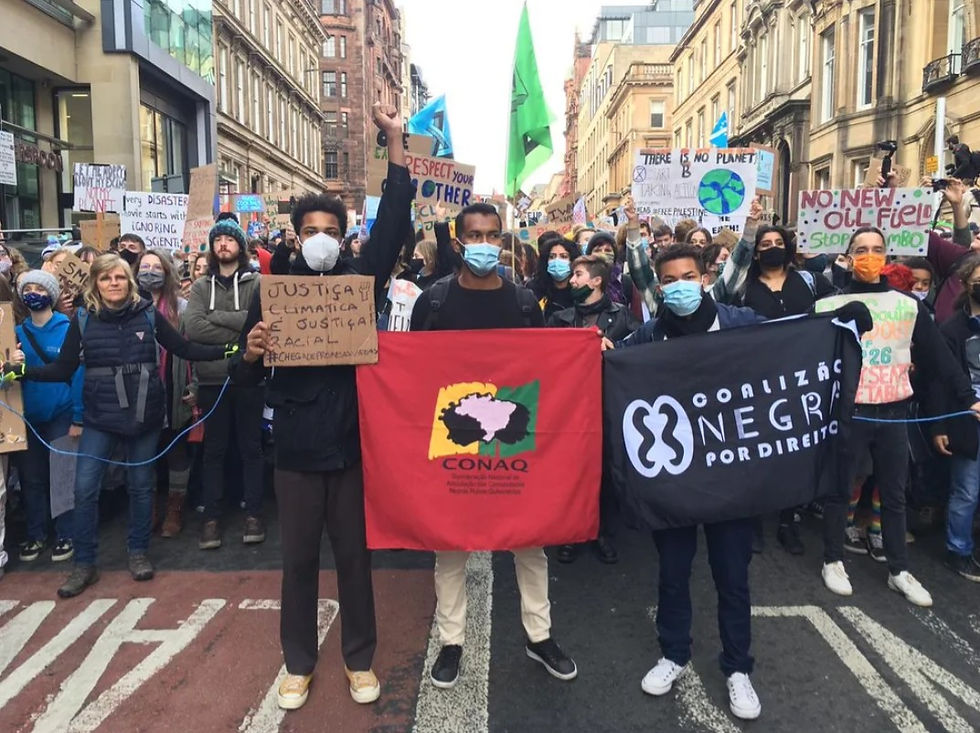
As Brazil marked the 50th anniversary of Black Consciousness Day, Black and Quilombola leaders reached a historic milestone in their decades-long struggle for political representation. For the first time in the 26-year history of the United Nations Climate Change Conference (COP), organizations representing Brazil's Black movement participated in significant numbers.
At a summit where Brazil reversed its previous opposition to carbon market negotiations and called for greater climate financing, civil society organizations emerged as some of the conference's most prominent voices.
Alongside Indigenous leaders, Black organizations argued that the climate crisis is also a human rights crisis, drawing attention to what they described as the ongoing genocide of Black communities and launching a manifesto calling for the formal recognition of Quilombola territories.
"The debate over climate justice is, by definition, a debate about human rights," said historian and activist Douglas Belchior, who joined the delegation of the Black Coalition for Rights in Glasgow.
"We want a preserved planet for the people who live on it. But some groups are allowed to live with dignity, while others are not."
According to Belchior, 2021 also marked the first time Black movement leaders toured the parliaments of Paris, Madrid, Berlin and Munich to denounce environmental racism and violence against Brazil's Black population.
"In 2021, we are still repeating the work Abdias do Nascimento carried out decades ago: exposing the genocide of Black people in Brazil. The world remains largely unaware of it, but the genocide continues."
A new chapter for Brazil's anti-racist movement
Environmental justice has long been part of the agenda of Brazil's Black movement. But the participation of more than 200 organizations represented by the Black Coalition for Rights — the country's largest alliance of Black organizations — marked a turning point in how structural racism is understood and confronted.
Dennis de Oliveira, a professor at the University of São Paulo and a researcher specializing in social movements, describes these moments as successive "waves" in the evolution of Brazil's anti-racist movement.
During Brazil's constitutional process in the late 1980s, he said, legal scholars mobilized around the criminalization of racism. Years later, the movement shifted toward education, following legislation that made Afro-Brazilian history and ethnic-racial relations part of the national curriculum. More recently, police violence became a central focus.
"All of these struggles are expressions of what we call structural racism," Oliveira said.
For him, the Covid-19 pandemic—which disproportionately affected Black Brazilians—brought new urgency to climate justice.
"In the post-pandemic world, the central question is the right to live with dignity," he said. "Environmental issues are not simply about protecting ecosystems. They are about protecting the lives of Black communities whose territories are being destroyed by industrial greed and the unsustainable extraction of natural resources. For Black and Indigenous peoples, this is not only about defending the environment—it is about defending their physical existence."
Belchior sees this shift as part of what he calls the constant evolution of racial oppression.
"The strategies of genocide evolve," he said. "So must our strategies for confronting them."
Environmental racism
Beyond the pandemic, activists argue there are deeper reasons why climate justice has become inseparable from the struggle against racism in Brazil.
On the eve of COP26, the Bolsonaro administration rejected the term environmental racism, which had appeared in a United Nations report describing the situation of Quilombola communities.
"When governments decide where to build hydroelectric dams, they overwhelmingly choose territories inhabited by the most vulnerable populations—Quilombola communities, Indigenous lands and traditional fishing communities," said Katia Penha, national coordinator of the National Coordination of Quilombola Communities (CONAQ-ES).
Penha was among the leaders representing more than 6,300 Quilombola communities at COP26, where they highlighted the impact of hydroelectric projects across the Amazon.
According to CONAQ, Brazil is home to approximately 16 million Quilombolas.
Although the United Nations had previously identified them as victims of environmental racism, COP26 marked the first time Quilombola leaders had participated in the climate summit.
"Who leads the environmental debate in Brazil today?" asked Selma Dealdino, executive secretary of CONAQ. "Mostly white, upper-middle-class people. Yet there are countless grassroots initiatives led by ordinary people who protect the territories where they live without exploiting or violating nature. Those are the voices that need to be heard."
Climate activist Marcelo Rocha, 26, pointed to environmental racism in Brazil's urban peripheries, drawing on his own experience growing up in Mauá, on the outskirts of São Paulo.
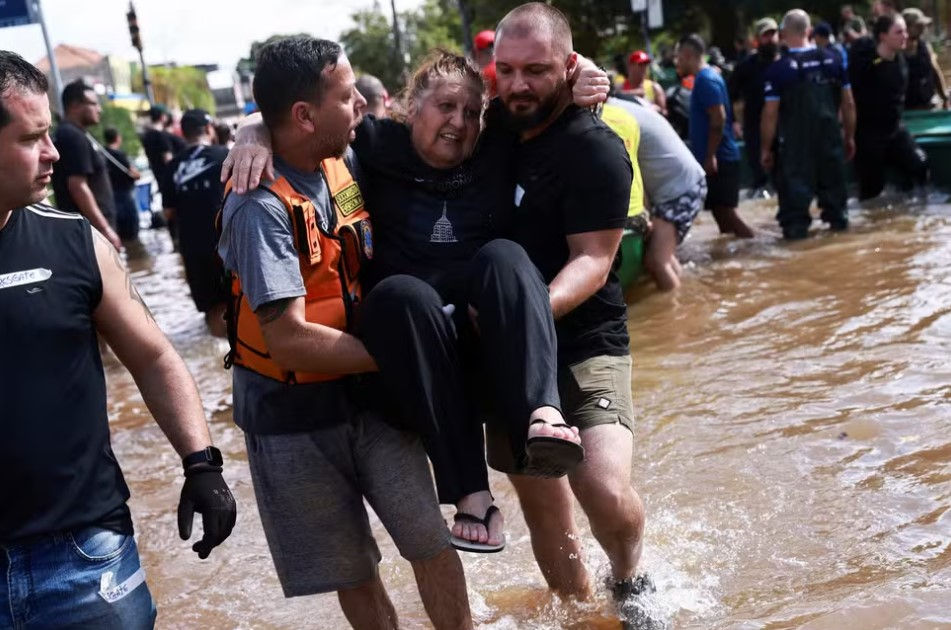
"Living in a peripheric neighborhood made me a climate activist because I only had to look around me to understand inequality," he said. "Who suffers the most when floods hit? My mother, who spent the entire day cleaning someone else's house and then had to spend the night at a train station waiting for the river to recede. This isn't an abstract debate. It's our everyday life."
Rocha later addressed thousands of people through the Fridays for Future platform in Glasgow. He argues that climate debates have become increasingly elitist, failing to address the immediate realities faced by poor communities.
"We're not all in the same boat. We face the same storm, but for Black people living in the periphery, our boat is a raft. While others are developing technologies to reach Mars, we're talking about how to eat today."
A historic turning point
According to geographer Diosmar Filho, coordinator of the research project Climate Change and the Recognition of Black Territories, the unprecedented participation of Black organizations at COP26 represented the largest political presence of Brazil's Black movement within the United Nations system since the 2001 Durban Conference against Racism.
"It took twenty years after Durban for us to reach this moment," he said.
Filho also warned that excluding Black and Indigenous communities from global climate negotiations risks creating a new cycle of resource extraction across formerly colonized regions.
"Few people ask where the minerals needed for electric vehicles or hydrogen-powered aviation will come from," he said. "Everything we know suggests those resources are concentrated in Africa, Australia and South America—including the Amazon. The transition to a green economy cannot become another cycle of colonial exploitation that once again violates people and territories."


Comments